About SpectrumSense Training
How Kim & Gina started their autism training program — as told by Kim.
I have been an auxiliary volunteer (non-firefighter/EMS role) with two local fire departments in Colorado — Evergreen and Genesee — for many years now. My (then) teenage daughter earned her Emergency Medical Responder (EMR) certification from the Evergreen Fire Department. I asked if she had received any autism training, as my oldest son has autism. “No.” I asked to see her EMR textbook and looked in the index under “A." There was nothing about autism. I then asked the firefighter training captain and EMS chief at the station if autism training was included in their curriculum: “Unfortunately, no.” I remember thinking, How could first responders not have training about autism?
So I got busy and put together a PowerPoint presentation. I worked on it diligently (I had very dirty toilets and lots of laundry piled up), adding things from my own knowledge from having an autistic son, plus doing a TON of research. When it was ready, I showed it to the same training captain and EMS chief on separate occasions and asked if I might be able to conduct training for the firefighters and EMS personnel. I got a HUGE thumbs up from both of them - something along the lines of, “Let’s do it! I think this is a great idea!” I was elated!! That was the beginning of our autism training program for first responders.
The EMS chief told me he could share my PowerPoint with the EMS coordinator from Centura Health (now CommonSpirit Health) whom they worked with (he said her name was Gina). Together, they could arrange for attendees to receive continuing education (CE) credits. Wow—this was becoming real!
Not long after, he told me he had spoken with Gina and that she was incredibly supportive. As it turned out, she also had a child with autism. What an unbelievable coincidence! Gina emailed me directly, kindly asking if I might be interested in partnering with her to deliver the training. She explained that she had an older son on the spectrum and was also a paramedic, which meant she could bring real-world case studies to the content I had already developed.
Um, YES, PLEASE!!
I jumped at that offer, since I served in an auxiliary role with both fire departments and had no firefighter or EMS background. Gina essentially filled a gap I didn’t even know I had.
We met for lunch and talked non-stop. I truly believe that when you meet another parent who has an autistic child, you are kindred spirits. It’s an immediate bond because you ‘get’ each other — you’ve been there, done that, got the tattoo. We talked about our autism journeys, and although very different, were also so similar.
———————
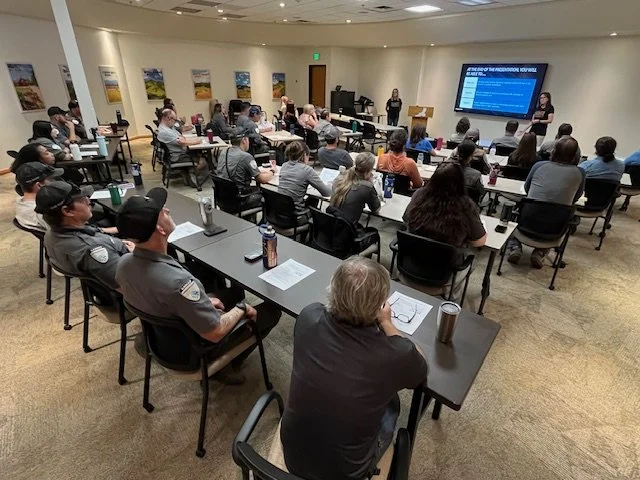
After initially presenting to firefighters, EMS, search and rescue, law enforcement, and park rangers, we expanded our training and now serve more audiences beyond first responders.
Our approach has two components:
Foundational: overview of autism, statistics, communication & behavioral signs, autistic meltdowns/neurocrashes, and how to interact with autistic individuals, especially when they are stressed (Kim’s part)
Interactive: hands-on activities and real-world case studies that explore how to handle challenging situations, plus ‘hands-off’ pain assessment techniques (Gina’s part)
Let’s face it - autism can be a heavy topic. Our goal is to help attendees remember those communication and behavioral traits, along with practical strategies for interacting with autistic individuals — simply stated — how to help. When presentations are fun and interactive (which they are!), attendees are more likely to stay engaged and retain what they’ve learned.
We also distribute handouts at the beginning of class. Their purpose is two-fold:
Follow along during the training, and
Take home for future reference.
They contain key foundational information, strategies for interacting with autistic individuals, and links to additional resources.
———————
Our research is constant — our eyes and ears are always open. We follow news articles, therapy approaches, autism non-profit foundations, and blogs. We explore communication apps, tracking devices, sensory support tools, and we talk with others in the field.
We have a vested interest because this work is personal for us — if more people understand autism, the world can become a little kinder, autistic individuals can feel more understood, meltdowns can be averted, and most importantly, lives can be saved. To be honest, we’re always thinking of our own sons.
We are committed to making a positive impact in the lives of individuals on the autism spectrum AND those who interact with them. Together, let’s foster a more inclusive and understanding society.
Learn more about our services.